Only 56% of decision-makers consider IT issues during the due diligence phase, per Deloitte.1 Yet, this factor is one of the clearest signs of whether the anticipated value will be realized.
Every buyer spends months testing the deal's logic, negotiating structure, and modeling synergies. However, they spend much less time understanding what technology they will inherit and what it will take to combine two different systems. Systems integration and consolidating outdated technology are consistently underestimated challenges in buy-side M&A.
The Situation: Two Companies, Two Technology Worlds
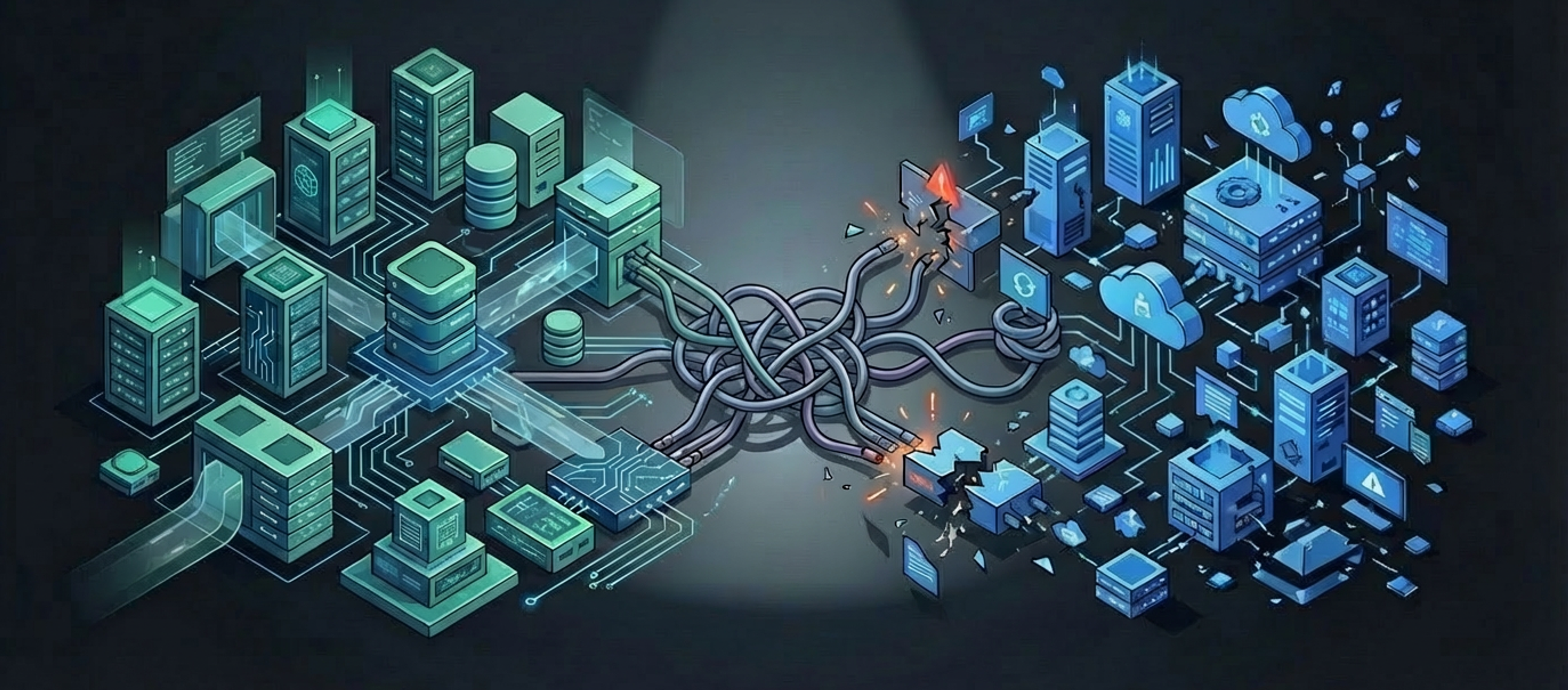
When a deal closes, most buyers focus on capturing synergies, retaining talent, and aligning their go-to-market strategies. The technology landscape often gets overlooked. The acquired company uses its own technology stack while the buyer operates on a different system. Neither was designed to work with the other.
This situation is more complicated than most deal teams expect. The inherited technology landscape usually includes:
- Outdated ERPs and on-prem infrastructure with undocumented dependencies
- Siloed databases that don’t connect across business units
- Custom-built applications that only a few people understand
- Duplicate software licenses across both companies, leading to unnecessary costs
According to Gartner, at least 25% of total M&A integration effort directly comes from IT, and over half of all integration activities depend heavily on IT.2 None of these systems show up as line items in a valuation, but they certainly appear in integration costs and timelines. Complete operational harmonization of complex legacy environments often takes 18 months or more, even when deal teams originally expect it to be six months.3

“IT is one of the most underpriced risks in M&A. Buyers model synergies down to the dollar but treat the tech stack like a rounding error. By the time the integration debt shows up, you're already behind on value creation and on your next deal, you start from a worse position than before.”

Kison Patel
Founder
M&A Science
Key Takeaway
For private equity-backed platforms with multiple acquisitions, the complexity grows with each deal. The lowest-performing acquirers have four to five times more applications and two to three times higher IT costs than top performers. Consequently, it costs them ten times more to execute the next integration.
The Threat: What Happens When This Gets Ignored
The data is clear:
- BCG found that 60% of M&A deals lack a standardized method for executing post-merger integration.5
- Bain & Company discovered that 70% of process and systems integrations fail at the very beginning, often due to poor IT planning.6
- KPMG reported that 70% of value erosion in post-merger integration occurs during the last integration phase. This often happens because earlier shortcuts create compounding technical issues.7
- The IMAA Institute found that 60% of companies facing failed IT integrations did not assign a dedicated team to the task8, leaving existing IT staff overloaded with day-to-day operations and integration work.
The damage from these failures manifests in predictable ways:
- Fragmented systems result in fragmented data, making it hard for leaders to have a clear view of the combined business.
- Duplicate software licensing costs reduce profit margins.
- Productivity drops as teams grapple with disconnected tools.
- Customer-facing disruptions increase churn risk at critical retention moments.

The overall effect is concerning. Deloitte's M&A Trends Report states that 70% of M&A deals fail to deliver the expected value. Bain & Company attributes 83% of those failures to poor integration execution, rather than flawed strategy.9, 10 IT systems integration is central to this execution gap.
Key takeaway
When integration debt builds up without addressing it, it expands with each deal and each system, until cleaning it up becomes more expensive than the original acquisition.
The Recommendation: Treat IT as a Deal Variable, Not an Afterthought
Getting this right does not mean completely overhauling how deals are done. It requires a few careful changes in how IT is regarded at every stage of the process.
Before signing:
- Involve IT leadership before finalizing deal economics.
- Map out legacy system dependencies and document integration complexity.
- Treat technical debt as a liability, not a mere footnote in financial models.
- Set realistic timelines: ERP migrations for enterprise targets usually average 12 months or more in practice.11
At close:
- Document sequencing decisions as part of the integration strategy.
- Act quickly on employee-facing systems like payroll, HR, and benefits, since delays breed uncertainty and retention risk.
- Follow up promptly with financial reporting and compliance systems, as regulatory needs do not pause for integration.
- Take a more thoughtful approach to engineering and customer-facing platforms, considering product roadmaps and customer impact.
Cisco's integration team serves as a good example. They clearly distinguish between systems that can be integrated quickly and those that require more careful handling, recording these decisions in the diligence materials rather than resolving them post-close.
Post close, by day 30:
- Ensure a dedicated IT integration team is already in place rather than forming one reactively when issues arise.
- For frequent acquirers, develop this team as a permanent internal capability instead of assembling a team for each deal.
For a $200M platform with a $30M EBITDA base: A dedicated three to four person IT integration team may cost $0.5–0.8M per year, but can shorten integration by several months and avoid unplanned capex and duplicated licenses.
The Benefit: Faster Synergies, Lower Risk, and a Stronger Platform for the Next Deal
Buyers who prioritize IT integration as a pre-close planning task consistently do better than those who treat it as a post-close issue:
- They realize synergies faster since the systems enabling them are ready from day one.
- Deal risk decreases because they have scoped and planned for technical complexity before closing.
- Each new deal becomes easier because the integration infrastructure and playbooks are already established.
- Integration debt stops accumulating because long-term issues are tracked, owned, and resolved rather than left unattended as the PMI deadline approaches.
Key takeaway
The accumulation advantage is significant in a market where deal volume is rebounding and competition for quality assets is increasing. The ability to integrate effectively is not just a nice-to-have; it stands out as a true differentiator.
Most of our work at Strategy MA is with serial acquirers and PE backed platforms that want integration to become a repeatable advantage, not a recurring fire drill. We help build the playbooks, governance, and IT integration muscle that make the third, fourth, and fifth deal easier than the first. If you would like a view of how your current integration approach compares with what top performing platforms are doing, we are happy to run a short diagnostic and share that perspective.
References:
[1] Deloitte, cited in Edvantis, IT Integration In M&A: The Complexities and Best Practices — https://www.edvantis.com/blog/it-integration-in-m-a/
[2] Gartner, cited in Infosys Knowledge Institute, The Five Pitfalls of M&A Integrations — https://www.infosys.com/iki/perspectives/five-pitfalls-integrations.html
[3] Panorama Consulting, Common ERP Challenges During Rapid Growth and M&A Activity — https://www.panorama-consulting.com/how-hard-is-it-to-modernize-erp-software-during-rapid-growth-or-ma/
[4] Bain & Company, Technology Merger Integration — https://www.bain.com/vector-digital/enterprise-technology/technology-merger-integration/
[5] BCG, From Buying Growth to Building Value, cited in Infosys Knowledge Institute (ibid.)